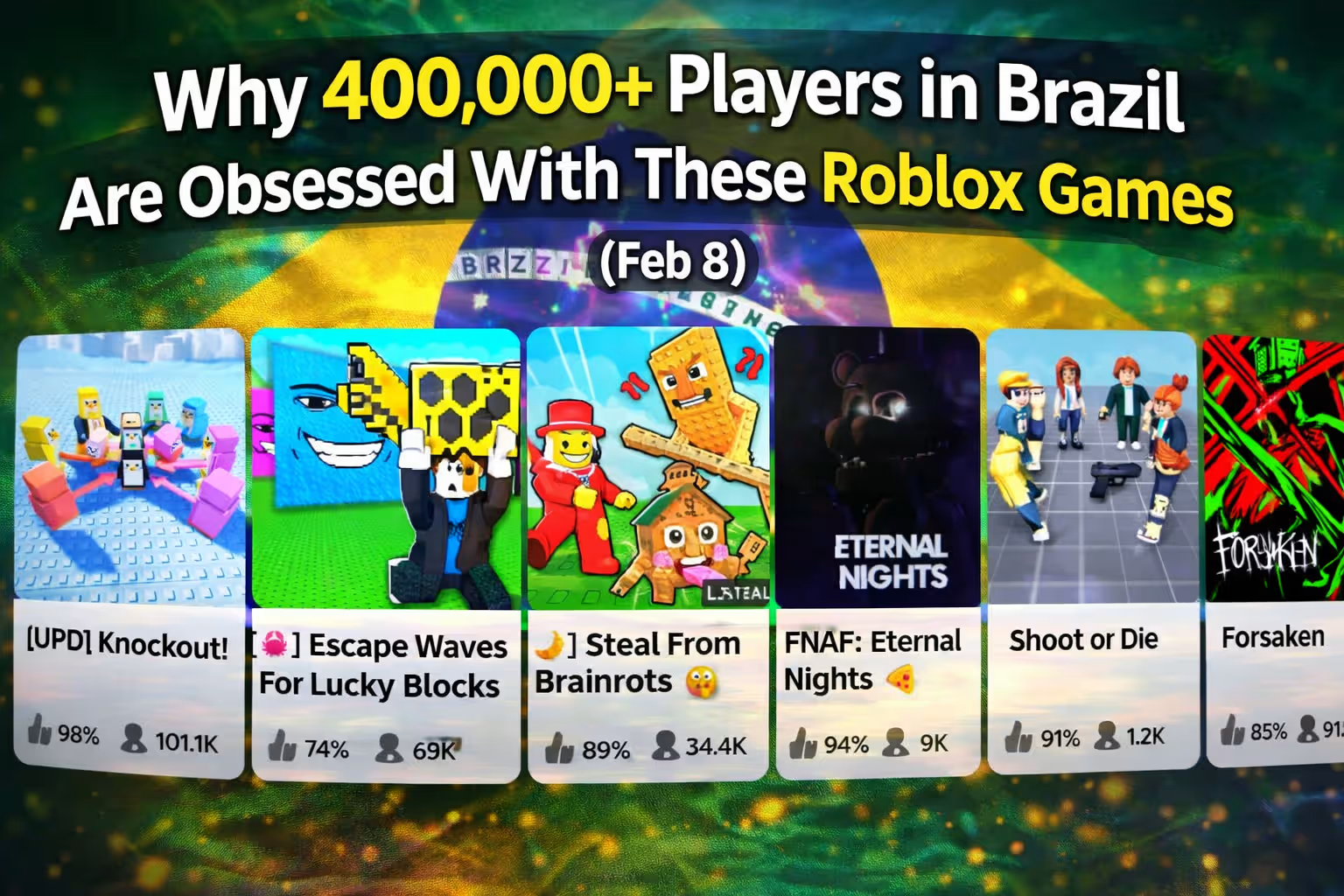
Why 400,000+ Players in Brazil Are Obsessed With These Roblox Games (Feb 8)
If you have been paying attention to global Roblox leaderboards, you might have noticed something extremely fascinating happening on February 8. While the standard global leaderboard was dominated by the usual heavyweights like Blox Fruits, Brookhaven RP, Adopt Me!, and Murder Mystery 2, Brazil’s local Roblox leaderboard looked completely unrecognizable.
Brazil is not just another region for Roblox; it is a global powerhouse. For the past four years, Brazil has remained Roblox’s second-largest market in the entire world, trailing only behind the United States. Latest industry estimates suggest that Brazil boasts over 22 million monthly active Roblox players, with an average of 450,000+ concurrent players online at any given time. To put this massive scale into perspective: there are more people playing Roblox in Brazil on a daily basis than the entire populations of over 100 different countries.
On February 8, as a professional gamer and content creator analyzing Latin American (LatAm) gaming trends, I tracked Brazil’s real-time concurrent player leaderboard. What I found was staggering. The top six games alone accounted for almost 400,000 concurrent players. Even more interesting is that this list defies almost every expectation an international Roblox player might have.
We didn’t see the massive, corporate-backed studio games. Instead, we saw a dynamic mix of hyper-casual PvP arena games, intense co-op horror survival experiences, and an absolute, undeniable domination of what the local community calls the “Brainrot” meme game trend.
Out of the top six games of the day, three are entirely based on the exact same viral meme that has completely taken over Brazilian social media. Beyond that cultural phenomenon, this leaderboard proves that Brazilian Roblox players have a very specific, highly refined taste. They demand games that are incredibly easy to learn, thrive on absolute chaos, are optimized for playing with large groups of friends, and act as the perfect canvas for TikTok and YouTube content creation.
In this comprehensive, massive 4,000+ word masterclass guide, we are going to break down every single game on this list. I will explain exactly what each game is, dive deep into the specific gameplay mechanics, analyze why Brazilian players cannot get enough of them, and share the elite, professional-level pro tips that local competitive players are using to dominate lobbies. We will also take a deep dive into the fascinating “Brainrot” meta that is single-handedly reshaping independent Roblox game development across Latin America.
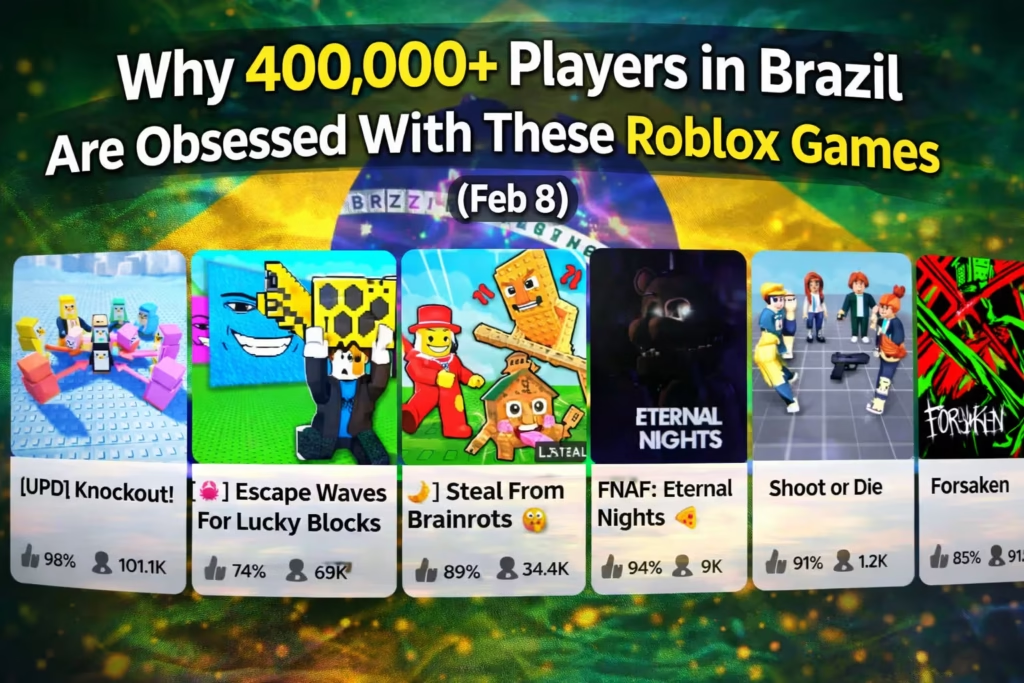
The Undisputed King of LatAm Gaming: Why Brazil Chooses Roblox
Most gamers outside of Latin America fundamentally misunderstand why Roblox has achieved such a god-like status in Brazil, far surpassing traditional AAA titles like Call of Duty, Fortnite, or League of Legends. To truly understand the February 8 leaderboard, we must look at the socioeconomic and cultural factors driving this gaming revolution.
1. The Reality of Hardware Accessibility
According to data from gaming research firms, a vast majority of Brazilian gamers do not play on high-end hardware. Heavy import taxes and economic factors mean that current-generation consoles (like the PlayStation 5 or Xbox Series X) and high-end gaming PCs are luxury items out of reach for the average teenager. Over 75% of young Brazilian gamers play on entry-level laptops, older generation smartphones (specifically budget Android devices), or tablets.
Roblox is a miracle of software optimization. It is one of the very few cross-platform games that runs flawlessly on a five-year-old budget smartphone. You can load into a massive 30-player server on a $150 Android phone and have the exact same competitive gameplay experience as someone playing on a $3,000 custom-built PC. This level of hardware democratization is an advantage that no other major gaming platform can compete with in the LatAm market.
2. The Ultimate Digital Third Space
For Brazilian youth, Roblox is not just a video game; it is a vital social platform. It operates as a digital “third space” (a place outside of home and school where people gather). Almost every student between the ages of 8 and 18 plays Roblox, making it the primary topic of conversation during school recess.
It is a daily ritual for massive groups of friends to hop on Discord or WhatsApp calls, join the same Roblox server after school, and spend hours hanging out. Unlike single-player narrative games or highly stressful ranked competitive shooters, every single popular Roblox game in Brazil is intrinsically designed around social interaction, cooperative chaos, and group laughter.
3. The Power of the Content Creation Ecosystem
Brazil boasts one of the largest, most vibrant, and most aggressive Roblox content creator ecosystems on the planet. There are hundreds of YouTubers, TikTokers, and Instagram Reels creators in Brazil who command audiences in the millions. These creators are trendsetters. They don’t just play Blox Fruits every day; their audiences demand novelty.
Creators are constantly hunting for weird, new, underrated games to showcase. When just two or three major Brazilian Roblox influencers make a video about a new meme game, that game can skyrocket from zero concurrent players to 50,000+ players in less than 48 hours. This hyper-viral ecosystem is exactly what fueled the massive numbers we saw on February 8.
4. Economics: Free-to-Play Done Right
Roblox is inherently free-to-play. While Gamepasses and Robux exist, the most popular games in Brazil share a common trait: they are 100% playable and enjoyable without spending a single real-world cent. In an economy where disposable income for digital microtransactions is limited, this is a make-or-break factor. Brazilian players despise “Pay-to-Win” (P2W) mechanics. If a game allows rich players to buy an unfair advantage, the Brazilian community will abandon it overnight. The games on this list succeeded because they respect the free-to-play user.
Demystifying the February 8 Leaderboard: The Power of Regional Algorithms
If you live in the US, the UK, or Asia, you probably looked at this list of games and thought, “I have literally never heard of any of these.” This isn’t because you are out of the loop; it is because of the brilliant way the Roblox discovery algorithm functions.
Roblox does not feature a unified global homepage. The “Discover” page and the games recommended to you are heavily customized based on geolocation, age demographics, past playtime history, and most importantly, what your local peers are playing. Roblox’s machine learning algorithm knows that players are significantly more likely to engage with games that are trending in their specific country because they share cultural touchstones, language, local internet memes, and a shared sense of humor.
Therefore, a game that goes massively viral in São Paulo might literally never appear on the homepage of a kid living in Chicago. This regional isolation creates fascinating micro-cultures. While Asian servers are currently obsessed with high-fidelity Anime RPG grinds, and North American servers are locked into trading simulators and long-term progression games, the Brazilian servers have morphed into an ecosystem of rapid-fire, high-energy meme and survival games.
Furthermore, the February 8 leaderboard highlights the sheer speed of Brazilian game development. Traditional Roblox games take months or years to build. The games dominating Brazil right now were built in a matter of days to capitalize on real-time internet trends. It is a masterclass in agile, community-driven game development.
Now, let’s dive deep into the 6 games that captivated 400,000 players in a single day.
🥇 1. Knockout! (101,000 Concurrent Players)
Against all odds, the most played Roblox game in Brazil on February 8 breaking the staggering 100k concurrent player milestone—is also mechanically the simplest game on the entire list.
If you are a Roblox veteran, you know that physics-based fighting games (like Slap Battles or Combat Warriors) have always maintained a solid player base. But Knockout! distills the fighting genre down to its absolute purest, most unadulterated form. There is no complicated lore. There is no confusing 50-hour RPG progression system. There is no grinding for rare loot drops. It is a pure, chaotic Player-vs-Player (PvP) arena brawler. The objective? Knock every other player off the floating platform before they knock you into the abyss.
Gameplay Mechanics & Meta
When you load into Knockout!, you immediately drop into one of six rotating, highly destructible arenas (ranging from a neon cyberpunk rooftop to a crumbling volcano crater). Because the maps are incredibly small, you are thrust into high-octane combat within three seconds of spawning.
Your character is stripped of complex movesets. You have exactly two primary abilities:
- The Light Jab: A quick, low-cooldown punch that does zero damage but applies a small amount of physical knockback.
- The Heavy Charge: A wind-up attack that leaves you vulnerable for 1.5 seconds but, if landed, sends the opponent flying across the map with massive force.
So, how does a game with only two buttons hold the attention of 101,000 players?
The secret lies in its flawlessly tuned physics engine and its remarkably high skill ceiling. Knockout! operates on the “Easy to learn, impossible to master” philosophy. The game heavily relies on momentum and animation canceling. Elite players have discovered advanced movement techniques.
For example, the community has coined a technique called “Wave-Dashing” (borrowing the term from Super Smash Bros. Melee). By jumping, immediately air-dashing into the ground, and canceling the landing animation with a Light Jab, players can slide across the arena at triple the normal walking speed. This allows highly skilled players to close the gap instantly, bait an opponent into using their Heavy Charge, dodge it via i-frames (invincibility frames), and punish them by knocking them off the edge during their cooldown state.
Why Brazil Loves It
Brazilian gamers are fiercely competitive, but as mentioned earlier, they despise Pay-to-Win games. Knockout! is the ultimate meritocracy. A player who started playing five minutes ago has the exact same stats, health, and damage output as a player who has logged 500 hours. The only difference is pure skill.
Furthermore, the match pacing is perfect for the modern attention span. A standard round lasts exactly three minutes. It is the perfect “waiting room” game. Kids play it while waiting for the school bus; teenagers play it while waiting for their friends to log onto Discord. It also generates incredible, highly shareable moments. The physics engine allows for hilarious ragdoll animations, making it a goldmine for TikTok gaming clips.
🏆 Pro Gamer Strategy Guide: Knockout!
- Master the Art of Baiting: The biggest mistake new players make is holding the W key and aggressively rushing the first target they see. In a 15-player lobby, aggression gets you killed. The current professional meta is “Edge-Guarding and Patience.” Stand near the center of the arena. Let the chaotic players fight each other on the edges. When they burn their stamina and miss a heavy attack, sprint in and clean up the surviving, vulnerable players.
- The 180-Flick Punish: Because Roblox relies on mouse-camera movement, you can manipulate hitboxes. If you are being chased, start charging your Heavy attack while running away. At the absolute last millisecond before the attack releases, flick your mouse 180 degrees. The momentum of your character combined with the sudden turn will snap your hitbox into the chasing player, launching them off the map before they can react.
- Use Verticality: Jump constantly. Grounded attacks have a fixed horizontal hitbox, but hitting a player while they are mid-air applies a 1.5x multiplier to the physics knockback because there is no ground friction to slow them down.
🥈 2. Forsaken (91,000 Concurrent Players)
While Knockout! thrives on simplistic, bite-sized PvP, our second-place game is a masterpiece of atmospheric tension and complex game design. Forsaken is a multiplayer, co-op psychological horror survival game that has been steadily climbing the Brazilian charts for a month before exploding into the #2 spot on February 8.
Drawing heavy inspiration from PC indie darlings like Lethal Company and Phasmophobia, mixed with classic Roblox horror elements from games like DOORS, Forsaken brings terrifying cooperative gameplay to the mobile and low-end PC market.
Gameplay Mechanics & Meta
What immediately separates Forsaken from the thousands of other generic horror games on Roblox is its server capacity. Traditional horror games limit parties to 4 players to maintain a tight atmosphere. Forsaken allows up to 12 players to join a single expedition. For Brazilian players, who travel in massive digital friend groups, this is a massive selling point. Nobody gets left behind in the lobby.
The lore drops players into the boots of urban explorers investigating an abandoned 1970s Amazonian mining town. Local legend states the miners unearthed something ancient and malevolent, causing the entire town to vanish overnight. Your team is dropped via helicopter with flashlights, limited stamina, and a single objective: locate 8 cursed relics scattered randomly across procedural map variants and seal the underground rift before the “Entities” pick you off one by one.
The tension in Forsaken is masterfully crafted through its audio design and AI programming. The primary antagonist doesn’t just teleport or run at you at Mach 10 with a cheap jump-scare. It stalks. It has an advanced pathfinding AI that prioritizes isolated players. You will be looting an abandoned cabin, and suddenly the ambient music cuts out. You hear heavy, dragging footsteps on the floorboards above you. You hear the wood creaking. The proxy-voice chat (which is a massive feature in this game) allows you to hear your friend screaming from two buildings over before their mic abruptly cuts to static.
The game heavily punishes “lone wolf” gameplay. If you wander off alone, your flashlight battery drains 2x faster due to a “fear” mechanic. To survive, teams must coordinate, share finite resources (like batteries, medkits, and temporary barricades), and communicate.
Why Brazil Loves It
Brazilians love playing games together, and nothing builds camaraderie quite like shared terror. Forsaken is the ultimate “scream with your friends” experience. Furthermore, the developer has been incredibly responsive. When the community complained that the game was too easy for 12-player lobbies, the developer released a “Nightmare Update” within 48 hours, adding proximity-triggered traps and a second, invisible entity that only attacks players who make too much noise in voice chat.
🏆 Pro Gamer Strategy Guide: Forsaken
- The “Lethal” Team Composition: You cannot win Nightmare mode by just running around randomly. Assign strict roles in the pre-game lobby. The optimal 12-man meta is: 3 Scouts (lightweight inventory, high stamina, meant to trigger traps safely and map the layout), 6 Mules (players dedicated to picking up the relics and walking them back to the center hub), and 3 Distractions (players equipped with Flare Guns and Air Horns whose sole job is to intentionally aggro the Entity and kite it away from the Mules).
- Audio-Baiting the AI: The Entity tracks sprinting sounds and voice chat volume. If one of your Mules is pinned down in a room, a Distraction player should stand 50 meters away, sprint in circles, and yell into their microphone. The AI will drop its current target and rush the loud player, giving the Mule a 10-second window to escape.
- Stamina Management: Never let your stamina bar drop below 20%. The Entity has a “Sprint Burst” ability it uses when it gets within 15 meters of a player. If you are exhausted when it triggers that burst, you are guaranteed to die. Always walk unless you have direct visual contact with the monster.
🥉 3. Steal From Brainrots (72,000 Concurrent Players)
Welcome to the most absurd, uniquely Brazilian phenomenon on the platform. Coming in at #3 with 72,000 players is Steal From Brainrots. To understand this game, you first have to understand the culture that birthed it.
In Western internet culture, the term “Brainrot” refers to overstimulating, low-attention-span content (like Skibidi Toilet or Subway Surfers gameplay split-screens). However, on Brazilian TikTok and Instagram Reels, “Brainrot” evolved into a very specific 3D-animated character meme. Around December 2025, a series of crude, low-poly, waddling creatures with massive, bugged-out eyes and incredibly distorted audio soundbites went ultra-viral in Brazil. These videos had zero narrative; they were purely surrealist, chaotic Gen-Z humor.
Roblox developers in LatAm are incredibly agile. Seeing this meme dominate every social media timeline, a solo developer built Steal From Brainrots in roughly five days. It became an overnight sensation.
Gameplay Mechanics & Meta
The premise is beautifully stupid. You spawn in a colorful, low-poly suburban neighborhood populated by hundreds of AI-controlled “Brainrot” NPCs. These NPCs waddle around aimlessly, holding massive golden coins. Your objective is to sneak up behind them, hold the ‘E’ key for two seconds to steal their coin, and return the loot to your personal vault to buy cosmetic upgrades and faster running shoes.
However, if you step into the frontal vision cone of a Brainrot, it becomes “Aggro’d.” It doesn’t attack you. Instead, it begins waddling toward you at a terrifyingly fast pace while blaring the ear-piercing, highly compressed, cursed audio meme that made it famous on TikTok.
One Brainrot chasing you is annoying. But their screams alert other Brainrots. Within 15 seconds, you can have a swarm of 50 Brainrots chasing you through the streets in a massive conga line of auditory assault. If the swarm physically touches your character, you “explode” into confetti, losing half of your stolen coins.
Why Brazil Loves It
This game is pure, unadulterated comedic chaos. It is the video game equivalent of a practical joke. Players don’t even play the game to win or collect coins; they play it to troll their friends. The physics engine allows you to jump over fences, slide under cars, and manipulate the AI pathfinding.
The meta of the game is essentially dragging a massive horde of screaming meme characters directly into your friend who is quietly trying to loot a building, getting both of you killed in the process while laughing hysterically in Discord. It is an unstoppable content machine. Every major Brazilian streamer has played this, generating countless highlight reels of them screaming as a wall of weird meme creatures corners them in an alleyway.
🏆 Pro Gamer Strategy Guide: Steal From Brainrots
- Exploit the Z-Axis: The AI pathfinding for the Brainrots is strictly coded for the X and Y horizontal axis. They cannot jump, and they cannot navigate complex vertical geometry. If you accidentally aggro a massive horde, do not run in a straight line down the street—they will eventually out-stampede your stamina. Instead, climb atop a parked car, jump to a lamppost, or scale a fence. The AI will stack up at the base, allowing you to easily escape or farm them safely.
- The “Crouch-Sprint” Glitch: The game’s detection radius is tied to your character’s stance. Standing creates a 10-meter detection sphere. Crouching reduces it to 2 meters. However, due to a quirk in the animation code, if you equip an item in your hotbar while crouching and immediately unequip it, you maintain the crouched stealth radius but move at full sprinting speed. Use this to glide through crowds of Brainrots completely undetected.
4. Escape Waves For Lucky Blocks (65,000 Concurrent Players)
Coming in at #4 is a masterclass in reviving classic Roblox nostalgia while updating it with modern mechanics. “Lucky Blocks” have been a staple of Roblox and Minecraft modding for over a decade. The concept is essentially gambling with game mechanics: you break a block, and it either gives you an incredibly overpowered weapon, a massive pile of health, or it spawns a nuclear bomb that wipes you and your team off the map.
Escape Waves For Lucky Blocks takes this high-stakes RNG (Random Number Generation) concept and merges it seamlessly with an intense, wave-based survival PvE (Player vs. Environment) mode.
Gameplay Mechanics & Meta
Up to 16 players spawn on an isolated, floating island. Every 90 seconds, the sky turns red, and a wave of progressively difficult enemies—ranging from standard zombies to massive, laser-firing mechs—spawns on the edges of the map.
If the server survives the wave, every player is rewarded with exactly one “Lucky Block.”
During the 30-second intermission between waves, players place their blocks and break them. This is where the game turns from a standard shooter into absolute madness. A lucky block can drop a hyper-advanced plasma rifle that one-shots enemies. It can drop auto-targeting turrets or healing auras.
But it can also drop devastating “Bad Luck” events. Breaking a block might spawn a cage around you that fills with lava. It might swap your inventory with the worst player on the server. It might instantly spawn a mini-boss right in the middle of your team’s carefully constructed base. The ultimate goal is to survive all 20 waves to trigger the server-wide “Legendary Block” rain, which gives players permanent cosmetic halos.
Why Brazil Loves It
Brazilians love games that balance luck with extreme skill. While the drops are pure RNG, surviving a bad drop requires elite teamwork. If a player gets a terrible drop and spawns a boss, the entire server must instantly pivot, communicate, and focus fire to save the run.
Furthermore, the late-game economy relies heavily on sharing and trading. If you get three sniper rifles from your blocks, but your teammate gets nothing but useless joke items, you have to toss them a weapon, or your team won’t have the DPS (Damage Per Second) required to survive Wave 15. It builds a beautiful, spontaneous community dynamic where random strangers have to work together to beat the odds.
🏆 Pro Gamer Strategy Guide: Escape Waves For Lucky Blocks
- The “Quarantine Zone” Opening: The fastest way to wipe a 16-player server is for everyone to open their lucky blocks in the center of the map at the exact same time. If one person rolls an explosive “Nuke Block,” everyone dies instantly. The professional meta is to designate the corners of the island as “Opening Zones.” You take your block to the edge of the map, break it, and if it spawns an environmental hazard, it only affects the edge, keeping the central defensive base safe.
- Synergy Over Rarity: Do not just equip the highest rarity weapon. Build synergies with your team. If a teammate rolls a “Cryo-Freeze Ray” (which does low damage but stops enemies from moving), you do not need another freeze ray. You need a high-damage area-of-effect (AoE) weapon like the “Rocket Barrage.” Communicate roles: have one player focus on crowd-control (slowing enemies), two on high DPS, and one dedicated to building walls with the “Fortress Spawner” item.
5. Escape Guards to Steal Brainrots (35,000 Concurrent Players)
Occupying the 5th spot is the spiritual, highly strategic successor to the #3 game. Escape Guards to Steal Brainrots was created by a rival development group who saw the massive success of the Brainrot meme and decided to inject it with hardcore stealth mechanics reminiscent of classic Metal Gear Solid games.
Gameplay Mechanics & Meta
The core objective remains gathering coins, but the dynamic has shifted entirely. You are no longer just avoiding dumb, waddling meme characters. The map is a massive, heavily fortified corporate facility, and it is actively patrolled by towering, highly intelligent “Brainrot Guards.”
These guards possess advanced line-of-sight vision cones (visible on your minimap), hearing radiuses, and dynamic alert phases. If a guard sees you, the game shifts from a funny meme to a high-stakes parkour chase. Unlike the original game where enemies just bump into you, the Guards carry batons that will instantly eliminate you and send you back to the lobby, stripping you of all your loot.
To counter this, players are given a massive arsenal of stealth mechanics. You can vault over cover, slide under laser grids, dive into dumpsters to break line of sight, and throw empty cans to create noise distractions in opposite hallways.
Why Brazil Loves It
This game appeals to the Brazilian players who loved the humor of the Brainrot meme but found the original game a bit too simplistic. It requires genuine mechanical skill, route memorization, and patience. The adrenaline rush of hiding in a locker while a massive, cursed meme character slowly stomps past the door, breathing heavily with distorted audio, is unparalleled.
It has also birthed a massive speedrunning community. Players are constantly uploading videos trying to route the absolute fastest path through the corporate facility, using movement tech and precise distraction throws to clear the map in record time without triggering a single alarm.
🏆 Pro Gamer Strategy Guide: Escape Guards to Steal Brainrots
- Abuse the “Investigate” State: Guards have three states: Patrol (Green), Investigate (Yellow), and Chase (Red). When you throw a rock, they enter the Yellow state and walk exactly to where the rock landed. However, while in the Yellow state, their peripheral vision is reduced by 50%. You can practically walk right past them while they are staring at the wall looking for the source of the noise. Constantly keep them in the Yellow state to manipulate their patrol routes.
- The “Dumpster I-Frame” Tech: Getting into a dumpster takes 1.2 seconds of animation time. During the final 0.4 seconds of that animation, your character is completely invincible and invisible to the AI. If a guard is mid-swing with their baton, interacting with a hiding spot at the last possible millisecond will completely negate the damage and force the guard to drop aggro instantly.
6. Save Brainrots from LAVA (34,000 Concurrent Players)
Rounding out the top six, we have the final entry in the “Brainrot Trilogy.” While the other two games positioned the Brainrots as enemies or guards, this brilliantly chaotic game flips the script entirely: The Brainrots are helpless, and you are their only hope for survival.
Gameplay Mechanics & Meta
Drawing inspiration from classic Roblox “Disaster Survival” games, Save Brainrots from LAVA places players on a massive, beautiful tropical island with a looming volcano in the center. Every round, the volcano erupts, and a rising tide of lethal, glowing orange lava begins to flood the map from the bottom up.
Hundreds of Brainrot NPCs are scattered across the beaches, the valleys, and the mountainsides. The problem? Their AI is intentionally programmed to be phenomenally stupid. They will wander aimlessly, walk into walls, and casually stroll directly toward the rising lava.
Your job as the player is to physically pick them up, put them on your back (which slows your movement speed), and sprint up the mountain to the safety of the Evacuation Helicopter before the lava consumes the map. The player who rescues the most NPCs before the 5-minute timer expires wins the round and earns premium currency.
Why Brazil Loves It
This is the ultimate test of physics-based hilarity. Carrying a Brainrot alters your character’s center of gravity. Trying to make precise parkour jumps over ravines of lava while carrying a heavy, screaming meme character on your back leads to some of the funniest fails in Roblox history.
It also heavily encourages friendly sabotage. The game features player-collision. If you and your friend are both running up a narrow bridge, you can absolutely shoulder-check them, causing them to drop their Brainrot into the lava to secure your own victory. It is competitive, cutthroat, and visually spectacular as the lava dynamic-lighting illuminates the crumbling island.
🏆 Pro Gamer Strategy Guide: Save Brainrots from LAVA
- The “Throw-Catch” Relay Technique: Walking up the mountain with a Brainrot is too slow. If you are playing with a friend, you can exploit the physics engine. Pick up an NPC, stand at the bottom of a cliff, and use the “Throw” command to launch the Brainrot vertically in the air. Have your friend stand on the ledge above and catch the NPC mid-air by spamming the interact key. This relay system allows you to transport NPCs up the mountain 4x faster than walking.
- Prioritize High-Altitude Spawns: Do not waste your time running all the way down to the beach at the start of the round. The lava rises fast. By the time you grab a beach NPC and run back up, the mid-level paths will be flooded. Immediately target the NPCs spawned on the middle elevation. You can clear them out quickly and safely, banking points while other players drown trying to be heroes on the shoreline.
The “Brainrot” Meta: A Deep Dive into LatAm Game Development
We cannot analyze this leaderboard without addressing the elephant in the room. Fifty percent of the top games in Brazil on February 8 are based on a singular, bizarre internet meme. How does this happen, and what does it mean for the future of the gaming industry?
The Psychology of Cultural Resonance
AAA game studios spend tens of millions of dollars on marketing campaigns trying to convince you to care about their brand-new characters and deep lore. Independent Roblox developers in Brazil have realized a brilliant shortcut: Cultural Resonance.
By utilizing a meme that currently dominates the local TikTok and Instagram algorithms, developers bypass the need for marketing entirely. When a 13-year-old Brazilian kid opens Roblox and sees a thumbnail featuring the exact same absurd character they’ve been laughing at on their phone all week, the click-through rate (CTR) is astronomical. They already understand the joke. They already have an emotional connection to the visual. It is instantaneous, frictionless marketing.
The Speed of Independent Agility
The developers behind the Brainrot games are not massive corporations. They are teenagers and young adults operating out of their bedrooms in São Paulo, Rio de Janeiro, and Curitiba.
Roblox Studio (the engine used to build these games) provides heavily modular, pre-scripted assets. A skilled developer can rip an audio file from TikTok, model a low-poly character in Blender in three hours, rig it to a basic pathfinding script, and have a functional prototype by dinner time.
These developers follow a strategy called “Trend Surfing.” They monitor social media algorithms. The second a meme gains traction, they build a game around it in under seven days. Is it high art? No. But it is a testament to the unparalleled democratization of game design. No other platform on earth—not Steam, not PlayStation, not Xbox, allows creators to capitalize on real-time global trends with this level of speed and agility.
Developer Economics
How do these developers make money if the games aren’t heavily Pay-to-Win? The answer lies in Roblox’s Premium Payouts and micro-transactions.
Roblox pays developers simply for keeping players engaged. If a player with a Roblox Premium subscription spends 20 minutes laughing in Steal From Brainrots, the developer earns a micro-fraction of a cent. Multiply that by 72,000 concurrent players holding sessions for hours at a time, and these solo developers are generating massive revenue streams purely through high engagement.
Furthermore, they monetize through social features: paying 50 Robux (about $0.50) to buy a custom funny hat for your character, or paying 100 Robux to trigger a server-wide funny sound effect. It relies on volume and social tipping rather than predatory loot boxes.
The Future of Roblox: Predictions for 2026
As we look at the data from February 8, several clear trends emerge that will define the rest of 2026 for Roblox, not just in Brazil, but globally.
- The Death of the Monoculture: We will no longer see one or two games dominate the entire globe. The algorithm is pushing regionalized content. Developers will increasingly need to localize their games not just translating the text into Portuguese or Spanish, but integrating local cultural humor and internet trends to survive in foreign markets.
- Session-Based Gaming is King: Notice that none of the top six games require a 40-hour grind. They are all highly replayable, short-session games. As mobile gaming continues to dominate the LatAm market, players want experiences they can jump in and out of in 10 minutes.
- Co-Op Over Solo: Single-player experiences on Roblox are dying. The platform is fundamentally a social network. Games that force player interaction whether through trading in Lucky Blocks, surviving in Forsaken, or trolling in Brainrot will always maintain the highest retention rates.
Conclusion
The February 8 Roblox leaderboard in Brazil is a fascinating snapshot of modern internet culture, technological accessibility, and sheer human creativity. It proves that you don’t need a hundred-million-dollar budget to capture the attention of 400,000 people. You need a good physics engine, a fundamental understanding of what makes people laugh, and a game that allows friends to create chaotic memories together.
Whether you are an aspiring game developer trying to understand the algorithm, a competitive gamer looking for the next big PvP arena, or just an observer of internet trends, the Brazilian Roblox market is the frontier of modern gaming. The Brainrot meme may fade in a month, replaced by whatever new joke goes viral on TikTok tomorrow, but the infrastructure, the agile developers, and the massive, hungry player base of Brazil are here to stay.
If you want to see the future of user-generated content, don’t look at the global front page. Look at Brazil.