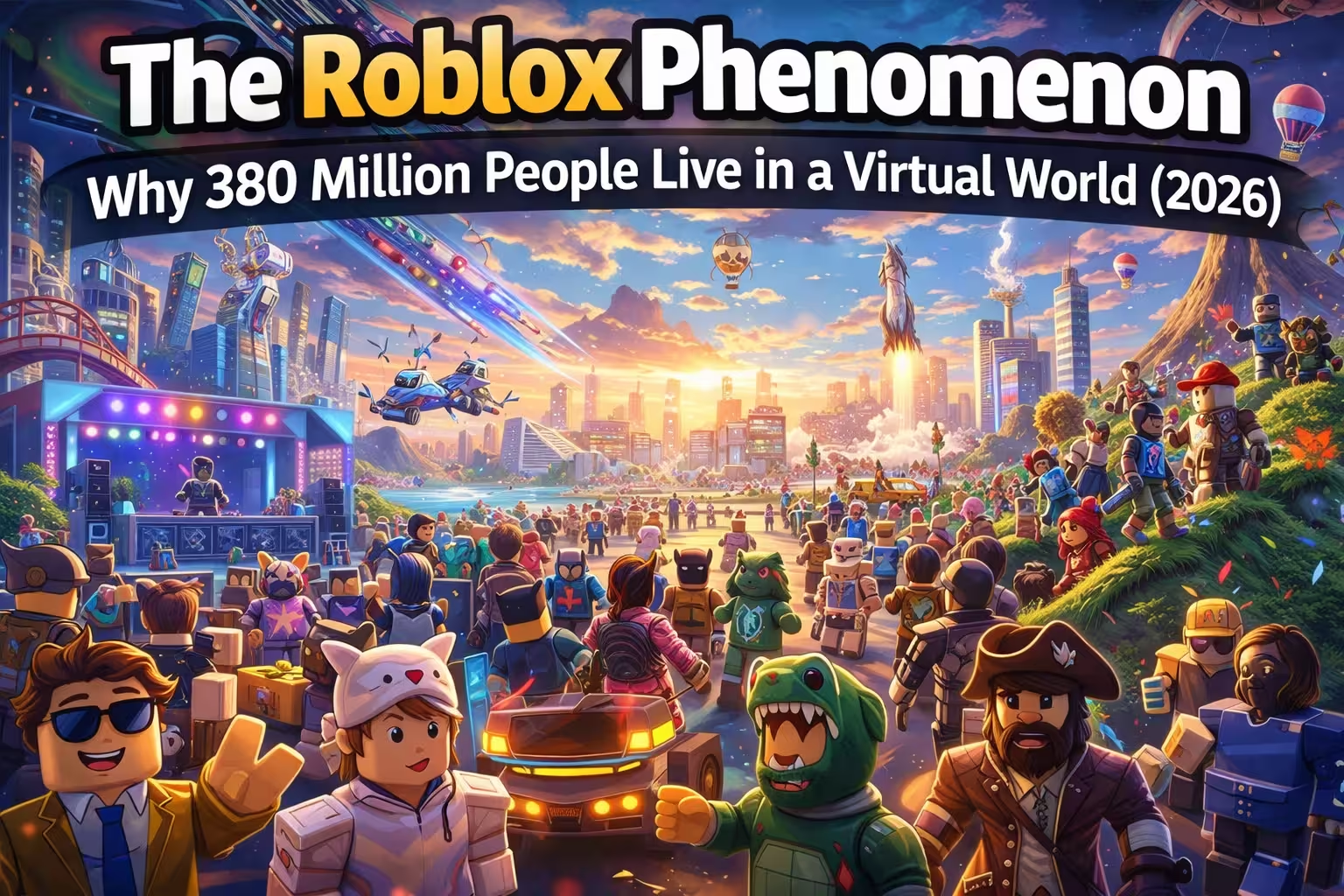
The Roblox Phenomenon: Why 380 Million People Live in a Virtual World (2026)
Remember when your parents told you to “stop wasting time on that blocky kids game”? Yeah, about that…
Roblox isn’t a kids game anymore. It hasn’t been for a while. And if you’re still thinking of it as some pixelated playground where children build virtual Lego houses, you’re about five years behind the curve.
Here’s what Roblox actually is in 2026: It’s a digital nation with a population larger than the United States. It’s an economy that rivals small countries. It’s where an entire generation is learning to socialize, create, and build their identities. And whether you’re a marketer trying to reach Gen Z, a parent wondering why your teenager spends six hours a day in front of a screen, or an investor looking for the next big platform, understanding what’s happening inside Roblox isn’t optional anymore.
It’s essential.
This isn’t going to be another dry statistics article full of charts and corporate speak. We’re going deep into the human story behind the numbers. Why are nearly 100 million people logging in EVERY SINGLE DAY? Why are 18 year olds choosing to hang out in virtual worlds instead of physical ones? And why are global fashion brands spending millions to dress up digital avatars?
The answers will surprise you. Let’s dive in.
The Numbers That Break Your Brain: Roblox’s Impossible Growth
Most social media platforms are struggling right now. Facebook is bleeding young users. Twitter (or X, or whatever we’re calling it this week) is chaos. Even TikTok is showing signs of user fatigue. Meanwhile, Roblox is accelerating like it’s shot out of a cannon.
Daily Active Users: Approaching 100 Million
As of early 2026, Roblox has approximately 91 to 95 million daily active users. Let me put that in perspective because the number is so large it stops meaning anything.
That’s more people than:
- The entire population of Germany
- All of California, Texas, and Florida combined
- Every person who attended the Super Bowl for the last 100 years, multiplied by 100
And these aren’t casual visitors. These are people who log in EVERY. SINGLE. DAY.
But here’s what makes this even crazier: they’re accelerating. Roblox grew by about 8 to 10 million daily users just in the last year. That’s like adding the entire population of New York City to your platform in 12 months.
Monthly Active Users: A Virtual Nation
Monthly active users now exceed 380 million people. If Roblox were a country, it would be the third largest nation on Earth, behind only China and India.
Think about that for a second. There’s a digital world that more people visit regularly than there are people living in the entire United States.
The Stickiness That Baffles Analysts
In tech, there’s a metric called the DAU/MAU ratio. It measures how often monthly users actually return daily. Most social platforms dream of hitting 15 to 20%. Instagram sits around 25%. Facebook is around 30%.
Roblox? They’re maintaining approximately 23 to 25% stickiness, and that number is CLIMBING.
This means nearly 1 in 4 people who visit Roblox in a given month are coming back every single day. They’re not just checking in. They’re habituated. It’s part of their daily routine like brushing their teeth or checking their phone first thing in the morning.
Time Spent: The Netflix Killer
Here’s where it gets really interesting. The average Roblox user spends 2.5 to 3 hours per day on the platform.
Let me repeat that: THREE HOURS PER DAY.
That’s not a quick scroll through social media. That’s not background noise while doing homework. That’s deep, focused engagement that rivals traditional entertainment platforms.
To put this in context:
- Average Netflix viewing time: 1.5 to 2 hours per day
- Average YouTube watching time: 1 to 1.5 hours per day
- Average TikTok scrolling time: 45 to 90 minutes per day
Roblox is beating all of them. Users are choosing to spend their limited attention budget in a virtual world instead of consuming traditional media.
Why? Because Roblox isn’t passive entertainment. It’s active participation. You’re not watching content; you’re creating experiences, building friendships, and expressing yourself. That level of engagement is addictive in ways that streaming video never can be.
The Great Aging Up: Your Teenager Is Not Alone
This is probably the most important demographic shift happening in digital culture right now, and most parents, educators, and brands are completely missing it.
Roblox is no longer a kids platform. Full stop.
The Age Breakdown That Changes Everything
Here’s what the current user base looks like in 2026:
Under 13 years old: 32 to 37% of total users
This is the age group everyone THINKS dominates Roblox. And yes, it’s still a huge chunk. But notice what it’s NOT: it’s not the majority anymore. For the first time in Roblox history, kids under 13 represent less than 40% of the user base.
Ages 13 to 17: 36 to 40% of total users
This is the core demographic now. High schoolers who grew up on Roblox and never left. They’re using it for social connection, creative expression, and entertainment in ways that would have been impossible five years ago.
Ages 18 to 24: 24 to 29% of total users
Here’s the demographic that’s absolutely exploding. College age adults and young professionals are the fastest growing segment on Roblox. Think about that: adults who could be doing literally anything else are choosing to spend hours in virtual worlds.
Ages 25+: 18 to 22% of total users
The “millennials are aging into Roblox” phenomenon is real. Parents who initially joined to supervise their kids are now staying because… they actually enjoy it. Plus, there’s a growing number of creators, developers, and business professionals who use Roblox as their primary income source.
Why Is This Happening?
The simple answer: Roblox grew up with its users.
Remember the kids who started playing Roblox during COVID lockdowns in 2020? They were 11 or 12 then. Now they’re 17 or 18. And instead of “aging out” of the platform like everyone predicted, they stayed.
Why? Because Roblox evolved.
Better Graphics: The engine now supports high fidelity avatars, realistic lighting, and environments that don’t look “blocky” anymore. You can create experiences that rival PlayStation or Xbox graphics if you have the skills.
Mature Content: In late 2023, Roblox introduced “17+ experiences” with age verification. This opened the door for horror games, mature storytelling, and social spaces designed specifically for older teens and adults.
Spatial Voice Chat: Being able to actually TALK to people instead of typing changed everything. Voice chat makes hanging out in Roblox feel like hanging out in person. It’s the difference between texting a friend and actually being with them.
Sophisticated Creation Tools: The scripting capabilities now rival professional game engines. Talented developers can build experiences that are genuinely impressive, which keeps them engaged as creators, not just consumers.
The Cultural Shift: The Digital Third Place
Here’s what older generations don’t understand: For Gen Z and Gen Alpha, Roblox isn’t “gaming.” It’s where they hang out.
Malls are dead. Movie theaters are struggling. Even hanging out at someone’s house requires coordination that feels exhausting. But Roblox? Your friends are always there. No planning required. No driving. No awkward parent interactions.
It’s become the “third place” that sociologists talk about. Not home (first place), not school or work (second place), but that informal gathering spot where community happens. For previous generations, that was the mall, the diner, the basketball court. For today’s teenagers and young adults, it’s Roblox.
Global Domination: Roblox Is Going East
If you thought Roblox was just an American phenomenon, you’re in for a surprise. The platform’s explosive growth is happening in places most Western observers aren’t even watching.
Asia Pacific: The Sleeping Giant Wakes Up
The Asia Pacific region is now the fastest growing market for Roblox, and it’s not even close.
Current numbers: APAC represents approximately 28 to 32% of total daily active users. That’s roughly 27 to 30 million people logging in every day from this region alone.
The mobile revolution: Unlike Western markets where many users play on PC or console, APAC is overwhelmingly mobile first. Smartphones are the primary gaming device, and Roblox’s mobile app is perfectly positioned to capture this audience.
Key markets driving growth:
The Philippines: One of the hottest Roblox markets in the world. Internet cafe culture is huge here, and Roblox has become the default “hang out” game in these spaces. Combined with strong English language penetration and a young population, it’s the perfect storm for growth.
India: With over 1.4 billion people and an increasingly connected youth population, India represents potentially the largest untapped market. Roblox is seeing exponential growth here, particularly in urban areas where smartphones are ubiquitous.
South Korea: The birthplace of PC bang culture is now falling in love with Roblox. Korean developers are creating some of the most sophisticated experiences on the platform, bringing K pop culture and Korean gaming sensibilities to a global audience.
Indonesia: Southeast Asia’s largest economy has a massive youth population that’s extremely online. Roblox is becoming the social platform of choice for Indonesian teenagers.
Europe: The Mature Market
Europe represents approximately 23 to 25% of daily active users, with about 22 to 24 million people logging in daily.
United Kingdom: The strongest European market by far. British teenagers and young adults have embraced Roblox as intensely as their American counterparts. The UK represents roughly 6 to 7 million daily users alone.
Germany: Despite a historically strong preference for PC gaming, German youth are increasingly choosing Roblox for social gaming experiences.
France: The French market is particularly interesting because it’s driving sophisticated fashion and social experiences on the platform. French creators are at the forefront of avatar customization and style.
Spain and Italy: Southern Europe is seeing rapid growth, particularly in the 13 to 17 age bracket.
North America: High Value Despite Slower Growth
The US and Canada represent about 20 to 22% of daily users (roughly 19 to 21 million people), but here’s the key: they generate the MOST revenue per user by far.
Why North America matters financially:
The average North American user spends approximately 2.5 to 3 times more on Robux than users in other regions. This is due to higher disposable income, more established payment methods, and a culture that’s more comfortable with digital purchases.
Premium subscriptions: Roblox Premium (the monthly subscription service) has much higher penetration rates in North America. These subscribers represent a disproportionate amount of total platform revenue.
Creator economy: The majority of top earning developers are still based in North America, which means revenue flows through the platform and back out to this region.
Latin America: The Next Frontier
Brazil, Mexico, and other Latin American countries are showing impressive growth trajectories. Currently representing about 12 to 15% of the user base, this region could become as significant as Europe within the next 2 to 3 years.
The key driver is increasing smartphone penetration and improving internet infrastructure. As connectivity improves, Roblox becomes accessible to millions of youth who previously couldn’t participate.
The Billion Dollar Creator Economy: More Than Just a Game
This is where Roblox stops being a gaming platform and starts being an economic revolution.
The Creator Payouts That Rival Tech Salaries
In 2025, Roblox paid out over $950 million to its community of creators. Let me break down what that actually means.
That’s nearly ONE BILLION DOLLARS going directly into the pockets of people (many of them teenagers) who build experiences on the platform.
To put this in perspective:
- YouTube paid creators about $15 billion in 2025 (but has been around much longer)
- TikTok paid creators about $2 to 3 billion (but has a much larger user base)
- Twitch paid out about $3 to 4 billion (but is primarily focused on streaming)
For a platform that’s essentially a game engine, paying out nearly a billion dollars to creators is INSANE. And that number is growing approximately 15 to 20% year over year.
The Top 1% Are Building Empires
The distribution of creator earnings follows the classic power law: a small percentage of creators earn the majority of revenue. But unlike other platforms, the top of this curve is REALLY high.
The mega studios: Games like Brookhaven, Adopt Me!, and Blox Fruits aren’t just successful Roblox games. They’re multi million dollar businesses.
Brookhaven (the most popular roleplaying game) likely generates $30 to 50 million annually for its creators. That’s not revenue for Roblox; that’s money going to the development team.
Adopt Me! (the pet trading/raising game) has been estimated to generate $50 to 100 million per year at its peak. The studio behind it employs dozens of people and operates like a legitimate game development company.
The mid tier success stories: Below the mega hits, there are hundreds of games earning $100,000 to $1 million+ annually for their creators. For context, that’s BETTER than what most indie games make on Steam or other traditional platforms.
A skilled developer can build a moderately successful Roblox game and earn more than they would at a traditional tech job. And they get to be their own boss, work from anywhere, and build exactly what they want.
The teenage millionaires: This is the part that blows people’s minds. There are multiple verified cases of teenagers (15 to 17 years old) who’ve become millionaires from Roblox game development.
These aren’t flukes or lucky breaks. These are talented developers who learned Lua scripting, game design, and monetization strategies, then executed at a professional level. Some of these teenage developers are now turning down college acceptances because they’re already earning more than most graduates.
The 70/30 Split Controversy
Roblox’s revenue model is controversial in creator communities. The platform takes approximately 70% of revenue generated (though the exact split varies based on how you calculate it and what costs you include).
Why developers accept this:
Even with a 70/30 split, the economics work because Roblox provides EVERYTHING: hosting, payment processing, moderation, discovery, social features, and a massive built in audience.
A 14 year old with a laptop and an idea can publish a game that reaches millions of people without spending a single dollar on infrastructure. That’s impossible on any other platform.
The comparison to other platforms:
- Apple App Store: Takes 30% (but you need to handle everything else yourself)
- Steam: Takes 30% (but you need to build your own multiplayer infrastructure)
- Epic Games: Takes 12% (but you’re competing with AAA games and have massive development costs)
When you factor in what Roblox provides, the 70/30 split starts making more sense for many developers, especially younger creators without access to capital or technical infrastructure.
The Career Path That Didn’t Exist Five Years Ago
Roblox has created a legitimate career path for digital creators that simply didn’t exist before:
Level 1: Hobbyist – Making a few hundred dollars per month from a small game Level 2: Part time creator – Earning $2,000 to $5,000 monthly, enough to supplement income Level 3: Full time indie – Earning $10,000+ monthly, treating it as their primary career Level 4: Studio founder – Managing teams, multiple games, earning six to seven figures annually Level 5: Mega studio – Operating like a real game company with dozens of employees and eight figure revenues
Thousands of people are now at Level 3 or higher. Hundreds are at Level 4. And a select few dozen are at Level 5, running actual businesses that compete with traditional game studios.
Gender and Diversity: Shattering the Gamer Stereotype
If you think gaming is still a “boys club,” Roblox is about to shatter that assumption into a million pieces.
The Numbers That Surprise Everyone
Current gender breakdown on Roblox (2026 data):
Male: 49 to 52% Female: 43 to 47%
Non binary/Prefer not to say: 3 to 5%
This is nearly PERFECT gender balance. For comparison:
- Steam (traditional PC gaming): Approximately 70 to 75% male
- PlayStation Network: Approximately 65 to 70% male
- Xbox Live: Approximately 65 to 70% male
- Nintendo Switch: More balanced at about 55 to 60% male
Roblox is the most gender balanced major gaming platform on Earth. And it’s not even close.
Why This Balance Exists
The secret is genre diversity. Roblox isn’t just one type of game; it’s millions of different experiences catering to every possible interest.
Combat and action games: These skew slightly male, as traditional gaming does Roleplay and simulation: These skew slightly female and dominate the most played charts Fashion and styling: Heavily female skewed, and massively popular Social hangouts: Nearly perfect gender balance Creation and building: Slight male skew, but much more balanced than traditional game dev
Because there’s something for everyone, everyone actually shows up. A platform with “fashion games” sitting next to “first person shooters” is naturally going to attract a more diverse audience than a platform focused on a single genre.
The Fashion and Identity Revolution
Games like “Dress to Impress” have dominated the Roblox charts throughout late 2025 and into 2026. This game, where players compete in fashion design challenges, regularly hits 200,000+ concurrent players.
For context, that’s more concurrent players than many AAA games on Steam. A fashion design game on Roblox is more popular than most “hardcore” games on traditional platforms.
This isn’t a fluke. It represents a fundamental shift in what “gaming” means to this generation:
Self expression matters as much as competition Social connection matters as much as gameplay mechanics Creativity matters as much as skill Style matters as much as score
And when you build a platform around these values, you get gender balance naturally because you’re not catering to a narrow definition of what games “should” be.
The Age and Gender Intersection
Here’s where it gets really interesting. The gender balance shifts depending on age group:
Under 13: Slight male skew (about 55% male) Ages 13 to 17: Nearly perfect balance (50/50) Ages 18+: Slight female skew (about 52% female)
This suggests that as the platform matures and adds more sophisticated social features, it becomes even MORE appealing to young women. The 17+ experiences in particular are seeing strong female engagement.
Your Avatar Is Your Identity: The Rise of Digital Fashion
In 2026, your Roblox avatar isn’t just a game character. It’s how you present yourself to the world. For many young people, their avatar is as important (or MORE important) than their physical appearance.
The Numbers Behind Avatar Culture
274 million avatar updates per day: Users collectively update their avatars this many times DAILY. Think about that. That’s people changing their digital appearance more often than they change their physical clothes.
Average number of items owned per user: 40 to 60 pieces of virtual clothing and accessories
Percentage of users who’ve purchased branded items: Approximately 68 to 72% of users have worn virtual items from real world brands at least once
The Brand Invasion (And Why It’s Working)
Major fashion brands have realized something crucial: Gen Z cares more about digital fashion than previous generations.
Brands currently on Roblox:
- Nike (multiple virtual stores and collections)
- Gucci (high fashion items selling for hundreds of thousands of Robux)
- Givenchy (luxury streetwear)
- Burberry (branded accessories and clothing)
- Ralph Lauren (casual and formal wear)
- Vans (skate culture items)
- Tommy Hilfiger (preppy fashion)
These aren’t just cheap promotional items. Some virtual Gucci items sell for 200,000 to 500,000 Robux. At current exchange rates, that’s $500 to $1,250 in real money. For a digital handbag.
And people are buying them.
The Physical to Digital Loop
Here’s the insight that makes brand executives lose their minds: 88 to 91% of young Roblox users say they use virtual fashion to “preview” what they might want to buy physically.
Let me explain why this is revolutionary for brands:
Instead of spending millions on traditional advertising that may or may not influence purchase decisions, brands can create virtual versions of their products that users actually INTERACT with. They wear them, see how they look, get feedback from friends, and develop preferences.
Then when they’re shopping in the physical world, they already know what they want because they’ve been “trying it on” virtually for weeks.
This is particularly powerful for fashion brands targeting Gen Z, who are notoriously difficult to reach through traditional marketing channels.
The Status Economy
In Roblox, your avatar communicates status just like designer clothing does in the physical world.
Rare limited items: Some items that were sold years ago now sell for millions of Robux on the secondary market. Wearing these communicates that you’re an “OG” user with either time investment or serious money.
Expensive branded items: Wearing Gucci or other luxury brands signals wealth and fashion consciousness, just like in the physical world.
Creator items: Some items created by famous Roblox developers are status symbols that show you’re connected to the creator community.
Custom avatars: Users with the skills to create truly unique, custom avatars are respected as having artistic talent and technical knowledge.
This digital status economy mirrors real world fashion culture perfectly, which is why it feels so natural to users who participate in it.
Safety, Moderation, and the Growing Pains of a Virtual Nation
With great size comes great responsibility, and Roblox is learning this lesson in real time.
The Moderation Challenge
Moderating a platform with 95 million daily users, millions of user generated experiences, and countless hours of text and voice chat every second is possibly the hardest moderation challenge in tech history.
The scale of the problem:
- Multiple languages and cultural contexts
- Users ranging from age 6 to 60+
- Constantly evolving slang and coded language
- Voice chat that’s harder to moderate than text
- User generated content that updates constantly
Traditional moderation approaches (human moderators reviewing flagged content) simply don’t scale at this level. You’d need hundreds of thousands of moderators working 24/7, and they still couldn’t keep up.
The AI Powered Solution
Roblox has invested heavily in AI powered moderation systems:
Large Language Models monitoring text chat across 20+ languages in real time, detecting harmful content, grooming behavior, and policy violations
Voice analysis AI that can identify concerning patterns in voice chat without requiring human moderators to listen to every conversation
Computer vision systems that scan uploaded images and 3D assets for inappropriate content before they’re even published
Behavioral analysis that flags accounts showing patterns consistent with predatory behavior, even if no single interaction crosses the line
These systems aren’t perfect, but they’re improving rapidly. And they represent the only feasible approach to moderating a platform at this scale.
Age Verification and the 17+ Revolution
One of the most significant safety improvements in 2025 was the expansion of age verification systems:
Facial recognition verification: Users who want to access 17+ content or enable certain social features must verify their age using government ID and facial recognition technology
Stricter chat restrictions: Users under 13 have heavily filtered chat with limited ability to share personal information
Separate experience categories: 17+ experiences are completely hidden from younger users, with no way to access them without verification
This creates a two tiered platform that can serve both children and young adults appropriately without forcing everyone into the lowest common denominator of safety restrictions.
The Ongoing Battle
Despite improvements, problems persist:
Predatory behavior: Bad actors still attempt to use Roblox to groom or exploit minors Inappropriate content: User generated experiences sometimes contain content that slips past filters Scams and fraud: From fake Robux generators to account theft Cyberbullying: Like any social platform, bullying and harassment occur
Roblox is in a constant arms race with bad actors, improving systems while those actors find new workarounds. It’s an ongoing battle that will never be fully “won,” only continually fought.
The Metaverse Vision: Where Is This All Going?
CEO David Baszucki has a clear vision: one billion daily active users. To understand why that number matters, we need to think bigger than gaming.
The Communication Revolution
Roblox is positioning itself not just as a gaming platform but as a communication platform that happens to have games.
Virtual events: Concerts, product launches, educational experiences, and corporate meetings are all happening in Roblox now
Digital offices: Some companies are experimenting with Roblox spaces for remote work collaboration
Educational institutions: Universities and schools are building virtual campuses for distance learning and collaboration
Social gatherings: Birthday parties, weddings, and other celebrations are increasingly happening in virtual spaces
If successful, Roblox becomes the place where humanity gathers digitally for ALL reasons, not just entertainment.
The Technology Roadmap
To reach the billion user goal, Roblox is investing in:
Photorealistic graphics: Making avatars and environments indistinguishable from real photos Haptic feedback: Integrating with VR controllers and future haptic suits for touch sensation Spatial computing: Better integration with AR glasses and mixed reality devices
Neural interfaces: Forward looking research into brain computer interfaces (seriously)
Some of this sounds like science fiction, but remember: five years ago, the idea of 95 million people logging into a blocky game world every day also sounded absurd.
The Economic Implications
If Roblox hits one billion daily users, it won’t just be the largest gaming platform. It will be:
- The largest social network (bigger than Facebook)
- The largest virtual economy (bigger than many physical economies)
- The largest creator marketplace (bigger than YouTube or TikTok)
- The largest virtual real estate market
- A legitimate parallel economy where millions earn their living
We’re not talking about a big gaming company anymore. We’re talking about a fundamental shift in how humans interact, create, and do commerce.
What This Means for Different Stakeholders
For Parents
Your child spending time on Roblox isn’t necessarily wasted time:
- They’re developing digital literacy skills
- They’re learning creativity and problem solving
- They’re building real friendships and social skills
- They might be developing career relevant programming skills
The key is balance and understanding WHAT they’re doing on the platform, not just how long they’re spending.
For Marketers and Brands
Ignoring Roblox means ignoring the primary social ecosystem for Gen Z and Gen Alpha:
- Traditional advertising doesn’t work here; authentic integration does
- Virtual products can generate real revenue and build brand affinity
- The data and insights available here are unprecedented
- Getting in early provides strategic advantages as the platform grows
For Developers and Creators
Roblox represents possibly the best opportunity for independent creators in the history of digital media:
- Lower barriers to entry than any other platform
- Larger potential audience than most gaming platforms
- Built in monetization and infrastructure
- Growing economy that’s lifting all boats
For Investors and Businesses
The numbers suggest Roblox is still in the early stages of growth:
- International expansion is just beginning
- Monetization per user is improving
- The creator economy is accelerating
- Adjacent opportunities (virtual real estate, brand partnerships, education) are untapped
The Human Story Behind the Statistics
Beyond all these numbers is something profound: a generation is creating new forms of community, identity, and economy in digital space.
They’re not “escaping reality.” They’re expanding it.
For them, friendships formed in Roblox are as real as friendships formed at school. Creative work done in virtual spaces is as valid as creative work in physical media. Time spent in digital worlds is as meaningful as time spent anywhere else.
This isn’t dystopian. It’s not sad. It’s just… different. And understanding that difference is crucial for anyone trying to understand modern youth culture, digital economics, or the future of human interaction.
The Third Place Phenomenon
Sociologist Ray Oldenburg coined the term “third place” to describe informal public gathering spaces separate from home and work. For previous generations, that was malls, diners, parks, and street corners.
For Gen Z and Gen Alpha, Roblox IS the third place. It’s where they:
- Hang out with friends without needing permission or transportation
- Express themselves through avatar customization and creative work
- Explore identity in lower stakes environments
- Build communities around shared interests
- Develop social skills and relationships
The death of physical third places (malls closing, public spaces becoming hostile to teenagers, helicopter parenting limiting unsupervised time) hasn’t made young people less social. It’s made them find new places to be social. And Roblox is the biggest of those new places.
The Identity Laboratory
For many young people, Roblox serves as a safe space to explore identity:
- Trying out different styles and presentations
- Experimenting with how they present themselves
- Testing boundaries and pushing comfort zones
- Finding communities that accept them
This is particularly important for LGBTQ+ youth, neurodivergent individuals, and others who might not feel accepted in their physical communities. In Roblox, you can be whoever you want, find people like you, and build supportive communities.
Frequently Asked Questions (FAQs)
Is Roblox actually making money or is it just hype?
Roblox generated over $3.6 billion in revenue in 2025, with the company being profitable or near profitable depending on the quarter. This is real revenue from users purchasing Robux (virtual currency) and subscription services. It’s not hype; it’s a massive, functioning economy.
How much do top Roblox developers actually earn?
The absolute top games (top 10 globally) likely generate $30 to 100 million annually for their development studios. Mid tier successful games can earn creators $100,000 to $5 million annually. Even smaller successful games can generate $20,000 to $100,000 per year. These are real businesses.
Is Roblox safe for my child?
Roblox has extensive safety features including chat filters, parental controls, age verification, and AI moderation. However, like any online platform with millions of users, risks exist. Parents should enable appropriate restrictions, monitor their child’s activity, and educate them about online safety.
What age group plays Roblox the most?
The 13 to 17 age group is currently the largest demographic (36 to 40% of users), followed closely by under 13 (32 to 37%). However, 18+ users now represent approximately 42 to 47% of the total user base, showing the platform is no longer dominated by children.
Can adults play Roblox without being weird?
Absolutely. Nearly half of all Roblox users are 18+. The platform has 17+ verified experiences designed specifically for adults. Adult users include creators, parents playing with children, and young adults who grew up on the platform. It’s normalized, not weird.
How does Roblox compare to Fortnite or Minecraft?
Different beasts entirely. Minecraft is primarily creation focused, Fortnite is primarily battle royale gaming, while Roblox is a platform containing millions of different experiences. Think of Roblox less like a game and more like YouTube: a platform where others create content you consume.
Why is Roblox so popular in the Philippines?
Strong English language skills, robust internet cafe culture, mobile first gaming adoption, large youth population, and cultural comfort with free to play models all combine to make the Philippines one of Roblox’s strongest markets globally.
Do people really spend hundreds of dollars on virtual items?
Yes. Some limited edition items sell for hundreds or even thousands of dollars worth of Robux. To collectors and serious players, these virtual items have real value based on scarcity, status, and personal significance. It’s no different than people spending money on other collectibles.
What’s the difference between Roblox and the metaverse?
Roblox IS a metaverse (or at least one version of it). The term “metaverse” describes persistent, shared virtual worlds where people socialize, create, and conduct commerce. Roblox fits this definition completely and is arguably the most successful metaverse implementation so far.
How much data does Roblox use?
Approximately 100 to 300 MB per hour depending on the experience. Games with simpler graphics use less data, while high fidelity experiences use more. This is relatively data efficient compared to streaming video (Netflix uses 1 to 3 GB per hour).
Can you actually make a living as a Roblox developer?
Yes, thousands of people do. However, like any creative career, success requires skill, dedication, marketing knowledge, and often some luck. The barrier to entry is low, but achieving top tier success requires real professional level skills.
Why do brands care about Roblox?
Brands care because that’s where young people are spending their attention. Traditional advertising channels (TV, print, even YouTube) are less effective at reaching Gen Z. Roblox provides direct access to millions of highly engaged young consumers in an environment where they’re receptive to brand experiences.
Final Thoughts: The Revolution Is Already Here
The mainstream media is still catching up to what’s been obvious to insiders for years: Roblox isn’t the future. It’s the present.
Right now, as you read this:
- Millions of teenagers are socializing in virtual worlds
- Thousands of creators are building viable careers
- Major brands are establishing permanent digital presences
- New forms of commerce and culture are emerging
This isn’t a trend that might happen. It’s a transformation that’s already happened. We’re just waiting for everyone else to notice.
The question isn’t whether virtual worlds will be important to the next generation. They already are. The question is whether existing institutions (education, business, government) will adapt to this reality or get left behind.
For individuals, the opportunity is clear: whether as creator, participant, or observer, understanding Roblox means understanding the digital culture that’s shaping our future.
The revolution won’t be televised. It’s happening in virtual worlds, built by teenagers, experienced by millions, and generating billions of dollars. And it’s only just beginning!
For more detailed trending roblox games or roblox game guides visit Bestbuyguides.